

What Is OTIF? How to Meet On-Time In-Full Requirements and Avoid Chargebacks

If you sell through major retailers, few metrics carry as much weight as OTIF. On-Time In-Full has become one of the most closely watched performance indicators in retail and supply chain operations. It tells retailers whether they can count on your shipments to arrive when promised and complete to the unit. Miss the mark, and you face penalties, shrinking margins, and strained relationships with the buyers who keep your products on the shelf.
OTIF is more than a number on a scorecard. It reflects how well every part of your operation works together. Inventory accuracy, fulfillment execution, and transportation performance all feed directly into your OTIF score. When one link weakens, your numbers slip and chargebacks follow. When those functions run smoothly, you earn the trust that drives bigger orders and stronger partnerships.
This guide breaks down what OTIF means, how retailers calculate it, why it matters for vendor compliance, and the practical steps you can take to improve your performance and avoid costly retail chargebacks.
What You’ll Learn About OTIF
- What OTIF means and why retailers rely on it
- How OTIF is calculated, with a clear example
- What a good OTIF score looks like
- Why OTIF impacts vendor compliance and chargebacks
- The most common causes of OTIF failures
- Practical ways to improve OTIF performance
- The role fulfillment partners play in OTIF success
What Is OTIF (On-Time In-Full)?
OTIF (On-Time In-Full) is a supply chain performance metric that measures whether an order arrives within the required delivery window and contains the complete quantity ordered.
That definition sounds simple, but the OTIF meaning carries real operational weight. To pass, a shipment must satisfy two conditions at once. It has to arrive on time, and it has to arrive in full. Falling short on either one counts as a failure.
Several factors shape whether your orders meet these standards:
- Delivery windows. Retailers set specific timeframes for when shipments must arrive. Deliver too early or too late, and the order misses the window.
- Must Arrive By Date (MABD). Many retailers assign an MABD to each purchase order. The shipment must reach the distribution center on or before that date.
- Appointment scheduling. Carriers often need to book delivery appointments. A missed or rescheduled appointment can push the shipment outside the approved window.
- Correct quantities. The order must contain exactly what the retailer ordered.
- Short shipments. Sending fewer units than ordered fails the “in full” requirement.
- Overages. Sending more than ordered can also trigger compliance issues.
OTIF connects directly to order fulfillment, inventory management, transportation planning, and overall supply chain performance. A strong score signals that your operation is reliable from the warehouse floor to the receiving dock. A weak score points to gaps that cost you money and credibility.
How Is OTIF Calculated?
The OTIF formula is straightforward:
OTIF % = (Orders Delivered On-Time and In-Full ÷ Total Orders) × 100
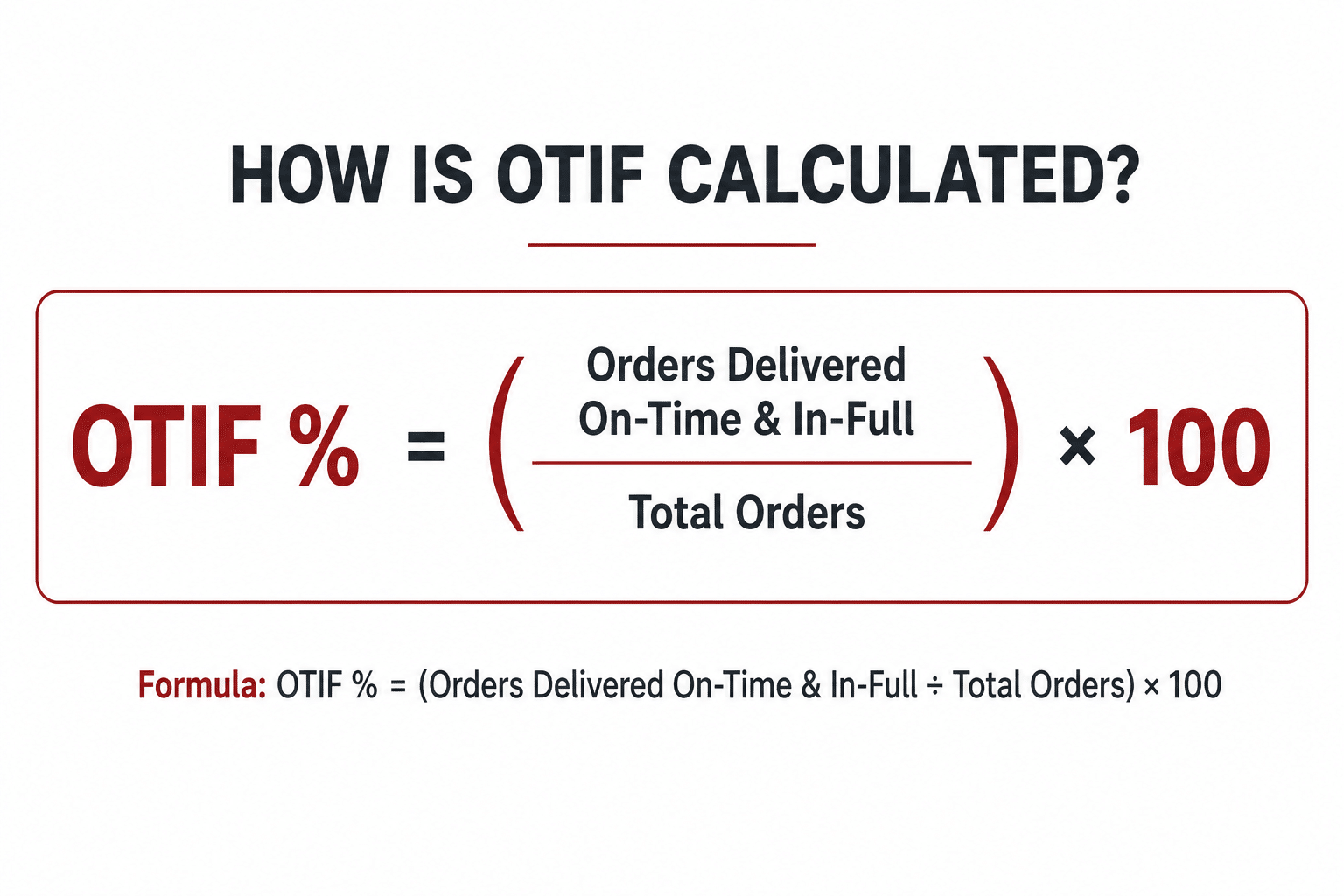
Here’s how it works in practice. Say you shipped 1,000 orders during a measurement period, and 950 of them arrived both on time and complete.
- Total Orders = 1,000
- Orders Delivered On-Time and In-Full = 950
- 950 ÷ 1,000 = 0.95
- 0.95 × 100 = 95%
- OTIF Score = 95%
A few points are worth emphasizing. Both conditions must be met for an order to count as a success. An order that arrives on time but short fails OTIF. An order that arrives complete but late also fails OTIF. There is no partial credit.
Retailers typically calculate OTIF using delivery window data, proof of delivery records, and the quantities actually received at their facilities. That means your internal records may not always match the retailer’s view, which is why visibility and accurate documentation matter so much
What Is a Good OTIF Score?
Expectations vary by retailer, but most use similar benchmarks to judge supplier performance. Here’s a practical reference for evaluating where your OTIF score stands:
|
OTIF Score |
Performance |
|
99%+ |
Excellent |
|
95%-98% |
Meets Most Retailer Requirements |
|
90%-94% |
Needs Improvement |
|
Below 90% |
High Chargeback Risk |
Many large retailers set their compliance threshold at 95% or higher. Drop below that line consistently, and you move into territory where penalties become routine and your standing with buyers begins to erode.
Why OTIF Matters for Vendor Compliance and Chargebacks
Retailers don’t track OTIF for its own sake. The metric sits at the heart of broader vendor compliance programs designed to protect shelf availability and keep distribution centers running efficiently.
When you ship to a major retailer, your performance feeds into a vendor scorecard. That scorecard rolls up OTIF alongside other compliance requirements to produce a supplier performance rating. A strong rating opens doors. A weak one invites scrutiny, financial penalties, and harder conversations during buying reviews.
Retail chargebacks are the most immediate consequence. When you violate a compliance requirement, the retailer deducts a fee from your payment to cover the disruption you caused. These deductions add up quickly and chip away at already thin margins.
Common chargeback causes include:
- Late deliveries that miss the assigned delivery window or MABD
- Short shipments that fail to meet ordered quantities
- ASN errors in advance shipping notices that create receiving problems
- Labeling violations such as incorrect or unreadable barcodes
- Routing guide violations when shipments don’t follow the retailer’s required carrier or method
- Missed delivery appointments that throw off dock scheduling
Beyond the direct cost, poor OTIF performance threatens shelf availability. If your products don’t arrive when expected, the retailer faces empty shelves and lost sales, which damages the relationship you’ve worked to build. For a deeper look at what these deductions cost and how to reduce them, see retail compliance chargebacks.
Common Causes of OTIF Failure
OTIF problems rarely come from a single source. They usually trace back to breakdowns in the operations that happen long before a truck leaves your dock. Here are the most frequent culprits:
- Inventory inaccuracies that create a gap between what your system shows and what’s actually on hand
- Stockouts that make it impossible to fulfill an order in full
- Picking errors that send the wrong items or wrong counts
- Packing errors that lead to damaged or incomplete shipments
- Transportation delays caused by carrier capacity, weather, or poor routing
- ASN errors that disrupt receiving and trigger compliance flags
- Retail compliance issues tied to labeling, documentation, or routing guides
- Forecasting challenges that leave you under-stocked during demand spikes
- Communication breakdowns between sales, warehouse, and transportation teams
- Limited supply chain visibility that hides problems until it’s too late to fix them
The key takeaway is this: most OTIF failures begin before transportation even starts. By the time a late or short shipment shows up on a retailer’s scorecard, the root cause is usually buried somewhere in your inventory or fulfillment process.
The Operational Factors That Impact OTIF
Strong OTIF performance depends on several interconnected operational processes. Even small disruptions in inventory, compliance, forecasting, or transportation can negatively affect OTIF scores. Understanding these operational factors can help brands identify weaknesses in their supply chain and improve OTIF performance over time.
Inventory Management and Visibility
Everything starts with knowing exactly what you have and where it sits. Reliable inventory management gives you the foundation to fulfill orders completely and on time. Focus on:
- Inventory accuracy so your records match physical stock
- Cycle counting to catch and correct discrepancies before they cause problems
- Inventory visibility that gives every team a real-time view of stock levels
- Safety stock planning to buffer against demand swings
- Demand forecasting that aligns supply with expected orders
- Inventory management systems that automate tracking and reduce manual errors
Retail Compliance and ASN Accuracy
Meeting a retailer’s rules is just as important as shipping the right product. Compliance gaps create chargebacks even when the goods themselves are correct. Pay attention to:
- ASN management that ensures advance shipping notices are accurate and timely
- EDI requirements for clean electronic data exchange
- Label compliance with correct barcodes and formats
- Routing guide compliance so shipments follow the retailer’s specified methods
Transportation Performance
The final stretch determines whether your shipment lands inside the delivery window. Transportation execution ties directly to on-time results. Strengthen:
- Carrier management to work with dependable partners
- Delivery scheduling that hits assigned windows
- Appointment compliance so dock times are booked and kept
- Shipment tracking for visibility from pickup to delivery
Coordinating these functions takes expertise and the right systems. Many brands turn to professional order fulfillment services to bring these pieces together under one roof.
How to Improve OTIF Performance
Improving OTIF requires a coordinated strategy that addresses inventory accuracy, visibility, compliance, and transportation performance across the entire supply chain. Treating any one of these in isolation rarely produces lasting results.
Improve Inventory Accuracy and Visibility
Accurate inventory is the single biggest lever for better OTIF. When you know what you have, you can promise and deliver with confidence. Build it through:
- Inventory controls that govern how stock moves in and out
- Quality assurance processes to catch errors before shipping
- Warehouse best practices for efficient, error-free picking and packing
- Real-time inventory visibility so decisions rest on current data, not yesterday’s snapshot
Strengthen Retail Compliance Processes
Tightening compliance reduces the avoidable chargebacks that drag down your score. Make it a priority to refine:
- ASN management for accurate, on-time shipping notices
- Retail requirements documented and shared across your team
- Vendor compliance programs that standardize how you meet each retailer’s rules
Optimize Transportation Performance
Smart transportation planning keeps shipments inside the window and lowers your delivered cost. Focus on:
- Carrier selection based on reliability, not just price
- Transportation planning that maps routes and timing in advance
- Freight optimization to balance cost and speed
- Delivery scheduling that aligns with retailer appointment systems
A strong logistics strategy often relies on dedicated transportation management services to coordinate carriers, schedules, and tracking at scale.
The Role of Fulfillment Partners in OTIF Success
Hitting consistent OTIF targets demands resources, systems, and expertise that many brands struggle to maintain on their own. A capable fulfillment partner brings all of that together and takes ownership of the operational details that determine your score.
The right partner improves OTIF performance in several ways. They deliver inventory accuracy through disciplined warehouse processes and real-time visibility. They coordinate transportation so shipments arrive within retailer windows. They manage retail compliance, from ASN accuracy to routing guide adherence, so you avoid the violations that trigger chargebacks. And they bring operational expertise that turns scattered processes into a reliable, repeatable system.
If your current OTIF score is costing you money and putting retail relationships at risk, now is the time to act. Review your recent performance, identify where orders are slipping, and consider whether your operation has the depth to meet rising retailer expectations.
FIDELITONE helps brands strengthen fulfillment, transportation, and compliance to drive measurable OTIF improvement. Explore our B2B fulfillment capabilities, or contact FIDELITONE to discuss strategies that can help you raise your OTIF score and reduce costly chargebacks.
OTIF FAQ’s
What does OTIF stand for?
OTIF stands for On-Time In-Full. It’s a supply chain metric that measures whether an order arrives within the retailer’s required delivery window and contains the complete quantity ordered. Both conditions must be met for the order to pass.
How is OTIF calculated?
OTIF is calculated by dividing the number of orders delivered on time and in full by the total number of orders, then multiplying by 100. For example, 950 successful orders out of 1,000 total orders equals an OTIF score of 95%.
What is a good OTIF score?
A score of 99% or higher is considered excellent. Scores between 95% and 98% meet most retail requirements. Anything in the 90% to 94% range needs improvement, and scores below 90% carry a high chargeback risk.
Why is OTIF important?
OTIF directly affects vendor compliance, retail chargebacks, and your standing with buyers. Strong performance protects shelf availability, preserves margins, and strengthens retail relationships. Poor performance leads to financial penalties and lost trust.
How can a fulfillment provider improve OTIF performance?
A fulfillment provider improves OTIF by delivering inventory accuracy, coordinating reliable transportation, and managing retail compliance. Their operational expertise and systems help brands consistently meet delivery windows and order quantities while reducing the errors that cause chargebacks.
FIDELITONE helps you earn customers’ loyalty through specialized services in inbound logistics, order fulfillment, last mile delivery and service parts management.
Newsletter Sign Up
Recent Posts
-

Shipping to UNFI or KeHE? 3 Fulfillment Challenges Growing Brands Should Prepare For
Growing from a direct-to-consumer (DTC) brand into retail distribution is an exciting milestone. Working with…
-

Parcel Peak Season 2026: Surcharges, Shipping Costs and What to Plan for 2027
Parcel peak season is approaching, and carriers have announced demand surcharges and temporary price increases…
-

What is Kitting? How Kitting Services Boost Your Business
Modern fulfillment is about more than shipping products from Point A to Point B. Businesses…
Are you interested in order fulfillment or last mile delivery services? Consult with a FIDELITONE expert to discuss how we can help.